
Explore this page
Royal Signs & Awnings provides design, production, and installation support for projects in and around Houston. Call (346) 658-2412 to discuss the location, goals, and options for your project.
Design the tent for recognition across an event
A custom canopy has two audiences: people approaching from a distance and visitors standing directly in front of the booth. The upper canopy and valance should make the organization easy to identify across a crowded event. Walls and table graphics can carry secondary details at closer range. Repeating a small logo many times is often less effective than giving the primary mark enough space. Strong contrast, uncluttered panels, and a clear front orientation help the display remain recognizable even when neighboring tents, flags, and people fill the background.
Choose walls according to how the booth will work
A back wall creates a branded background and visually separates the booth from activity behind it. Side walls can add privacy, shade, or display space, but too much enclosure may make an inviting booth feel closed. Half walls can define a boundary while preserving conversation. The right configuration depends on staffing, product display, sun direction, photography, storage, and visitor flow. Planning these details before artwork prevents important graphics from being hidden behind tables, equipment, or personnel.
Create a kit, not an isolated tent
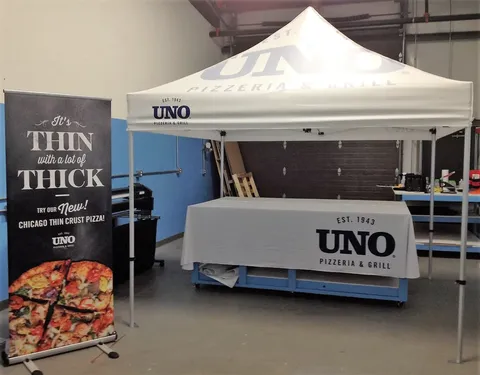
The most effective event setups feel coordinated. A table cover can bring the brand down to eye level, a banner can explain the offer, and a backdrop can support photos or presentations. Printed pieces should share colors, type, and image treatment, but each should have a specific role. The canopy identifies the booth; the table establishes the front counter; supporting graphics explain or promote. A modular kit also lets the team use only the pieces appropriate for a small event and expand the setup for a larger one.
Prepare artwork for fabric and real-world viewing
Artwork that looks crisp on a screen still needs to be adapted for a large fabric surface. Logos should be supplied as vector files when available, and brand colors should be identified clearly. Fine lines, tiny text, low-resolution images, and details placed near seams may not reproduce as intended. A proof should show each visible panel and its orientation. The team should also confirm which side is considered the front, because a tent viewed from several directions needs deliberate logo placement rather than one flat layout copied everywhere.
What to consider before ordering a custom branded canopy tent
The strongest projects begin with a short, concrete brief. Identify the main audience, the most important viewing direction, the message that must be understood first, and the action the viewer should take. For this page, the central planning question is selecting a readable graphic layout, appropriate coverage, useful walls and accessories, manageable setup, and a coordinated display that can be reused. Share current photos, approximate dimensions, brand files, property requirements, and the desired timing. Those details allow recommendations to respond to the real site instead of relying on assumptions. They also make it easier to separate must-have performance requirements from optional visual upgrades.
Options that can be matched to the project
Relevant solutions may include printed canopy tops, branded valances, full and half walls, back walls, coordinated table covers, banners and flags, carrying solutions, and replacement graphic components. These are not interchangeable products. Each has a different strength, cost structure, viewing pattern, and installation need. The right selection depends on an outdoor market, community event, school function, registration area, promotion, recruiting event, or mobile customer-service setup. Royal Signs & Awnings can help compare practical alternatives in the context of the brand and property. A useful comparison explains how each option communicates, what supporting conditions it needs, how it may be maintained, and where it fits within the larger sign or display system.
Design for legibility before adding detail
People should understand the primary message without studying the display. That requires a clear hierarchy: brand or destination first, essential supporting information second, and optional detail only where viewing time allows it. Letterform, spacing, contrast, color, and surrounding negative space work together. A proof should be reviewed at a scale that reflects actual use, not only enlarged on a monitor. For custom branded canopy tent projects, simplifying a busy logo treatment or relocating secondary text can improve recognition without changing the identity of the brand.
Site review and accurate project scope
A site review connects design ideas to physical conditions. The team may need to verify dimensions, surfaces, access, sightlines, electrical availability, existing components, nearby obstacles, and property procedures. For work at an outdoor market, community event, school function, registration area, promotion, recruiting event, or mobile customer-service setup, small conditions can influence the recommended construction or installation method. The scope should state what is being supplied, what existing elements are being reused, which approvals are the customer's responsibility, and which assumptions still require confirmation. Clear scope language helps the customer compare proposals on equal terms.
Materials and finishes should support the environment
Material selection is not only an appearance decision. Weight, rigidity, finish durability, light transmission, cleanability, attachment, and replacement needs can all matter. Colors and textures should be evaluated alongside the building or event environment, because samples viewed indoors may respond differently in direct sun or artificial light. The practical objective is a custom branded canopy tent that presents the brand well and can be cared for sensibly. Where components will age at different rates, the design should allow service or replacement without forcing an unnecessary rebuild.
A straightforward project process
A typical project moves from discovery to field verification, concept development, proofing, production planning, fabrication or printing, and installation or delivery. The sequence may change when landlord review, property coordination, permitting, engineering, electrical preparation, or special access is involved. Customer approvals are meaningful checkpoints: names, spelling, colors, dimensions, quantities, placement, and message content should be confirmed before production. A realistic schedule begins only after dependencies are known. This reduces rushed decisions and gives Sugar Land businesses, schools, nonprofits, event teams, vendors, contractors, sports groups, and organizations that need a portable branded shelter a clearer understanding of what happens next.
How to prepare for a useful quote
Send several wide and close photos, the project address, the business name exactly as it should appear, usable logo files, approximate measurements, and a short explanation of the goal. Include lease or property criteria if they exist. Note whether the project replaces something already installed and whether power, access equipment, or removal may be needed. It is also helpful to identify the decision maker and target date. A budget range can guide the team toward realistic alternatives, but the final recommendation should still explain the tradeoffs rather than simply reducing size or quality without context.
Protect the investment after completion
Keep approved artwork, color references, drawings, product details, and service contacts with the property records. Periodic visual checks can catch loose components, water marks, fading, blocked visibility, surface damage, or lighting changes before they become larger problems. Cleaning methods should suit the face and finish; harsh chemicals or improvised pressure washing can damage graphics and seals. If the brand changes, review which components can be updated and which should remain. Documentation makes later repairs, replacement parts, tenant changes, and repeat orders more accurate.
Why work with Royal Signs & Awnings for canopy tents Sugar Land TX
Royal Signs & Awnings approaches signage as a business communication project grounded in the site. The conversation begins with how the customer should find, understand, or interact with the brand. From there, the team can develop a practical path through design, production, and installation or delivery. Clients can discuss one immediate need or a coordinated set of signs. For a quote, call (346) 658-2412 or send the project address, photos, artwork, and goals through the contact form. The more specific the starting information, the more useful the first recommendation can be.
Questions to resolve before approval
Before approving the custom branded canopy tent, confirm the exact message, spelling, colors, quantity, orientation, and placement. Ask what is included in installation or delivery, what the customer must provide, and what conditions could change the price or schedule. Confirm whether removal, surface repair, electrical work, access equipment, or property coordination is included. These checks are simple, but they prevent many misunderstandings and give everyone one approved reference for the work.
Measure success in practical terms
The purpose of this project is clearer customer communication. After completion, observe whether people identify the location sooner, ask fewer directional questions, notice the intended message, or interact more confidently with the space. Photography can document the finished work, while staff feedback can reveal problems that are not obvious in a proof. If the custom branded canopy tent is part of a wider program, these observations can improve the next phase and help the business develop more consistent standards.
Keep the message current
Even a durable sign or display can lose value if the information around it becomes outdated. Review phone numbers, hours, tenant names, service descriptions, promotional dates, and directional language whenever operations change. Remove temporary additions that obscure the main design. When an update is needed, start from the approved files rather than rebuilding artwork from a photograph. Small, orderly updates preserve credibility and are usually easier to manage than waiting until several mismatched changes have accumulated.
Related sign and display options
Explore: Canopy Tents • Custom Tablecovers • Large Banners • Trade Show Displays • Printed Backdrops
Request a quote
Tell Royal Signs & Awnings what you need, where it will be used, and what you want customers to notice first. Call (346) 658-2412 or use the website contact form to share the project address, photos, artwork, and timing.
Let’s talk about your sign.
Share your location, artwork and project goals with our Houston team.
Request a ConsultationPROJECT QUESTIONS
Frequently asked questions
What artwork is best for a custom canopy tent?
Vector logo files are preferred. Also provide brand colors, fonts, placement priorities, and any images at suitable resolution.
Can walls be added to a branded canopy?
Yes. Full walls, half walls, and back walls can add branding, privacy, shade, or display area depending on the event setup.
Can the tent match table covers and banners?
Yes. A coordinated kit can use consistent colors and graphic treatment while each piece carries a different level of information.
How much text should go on the canopy?
Keep upper panels simple: usually the name or logo and a short identifier. Detailed services and calls to action are better on closer-view graphics.
What should I send for a quote?
Send the logo, brand guidelines, desired configuration, visible sides, accessory needs, quantity, delivery timing, and examples of the events where it will be used.